
September 11, 2001
World Trade Center • Pentagon • Shanksville, Pennsylvania
Like so many others around the country, Jan-Care personnel and management learned of the attack on the World Trade Center shortly after the first aircraft struck at 8:48 a.m. There was immediate confusion about what had happened and why.
Nearly all key management personnel were gathered around the television in Jan-Care's command center and witnessed the second aircraft strike at 9:03 a.m., the attack on the Pentagon at 9:37 a.m., and the collapse of the South Tower at 9:58 a.m. EMS command discussions quickly centered on the scale of the destruction and on a practical question familiar to emergency responders: how would Jan-Care crews respond if an incident of that magnitude occurred inside our own primary coverage area?
Minutes later, United Airlines Flight 93 crashed in Pennsylvania at 10:03 a.m. The concern in Jan-Care's command center grew as the magnitude of the attack became clear. The crash site was less than 80 miles from Jan-Care's Morgantown EMS station. Crews there went on high alert while leadership considered whether mutual aid might be requested and whether survivors could still be reached.
Then, at 10:28 a.m., the World Trade Center's North Tower collapsed. In one hour and forty minutes, the consciousness of an entire nation had changed.
There was fear and uncertainty, disbelief and anger, but one thing was clear within Jan-Care: the organization needed to do something to provide aid and demonstrate support for the country and for New York City. Developing a response plan became the first priority, and team members were contacted and assembled from across Jan-Care's nine-county coverage area.
Ambulances were prepared and staged at the corporate office. The Emergency Response trailer was loaded with mass-casualty and rescue equipment. In the uncertainty of those first hours, Jan-Care personnel also had to have difficult conversations with family members. The organization was responding, but no one yet knew how long the deployment might last. Family responsibilities, pets, appointments, and the ordinary details of daily life all had to be reconciled in a matter of hours.
The West Virginia State Emergency Operations Center contacted Jan-Care and requested formation of an emergency response team that could stand ready for possible incidents within West Virginia. Two of the four aircraft used in the attacks had crossed West Virginia airspace, and the state contained several nationally significant facilities and industrial sites. In those first uncertain hours, the possibility of additional attacks could not be dismissed.
They traveled in four emergency vehicles carrying rescue rope bags, triage kits, and additional medical supplies, headed toward New York.
The Jan-Care Response Team
The team arrived in Jersey City at approximately 7:00 a.m. on September 12. Their first assignment was to establish a triage area at the entrance to the underwater subway connection between Jersey City and New York City. The fire department was attempting to locate a subway car believed to have become disabled inside the tunnel following the power failure. That mission was later called off after the tunnel was searched and cleared.
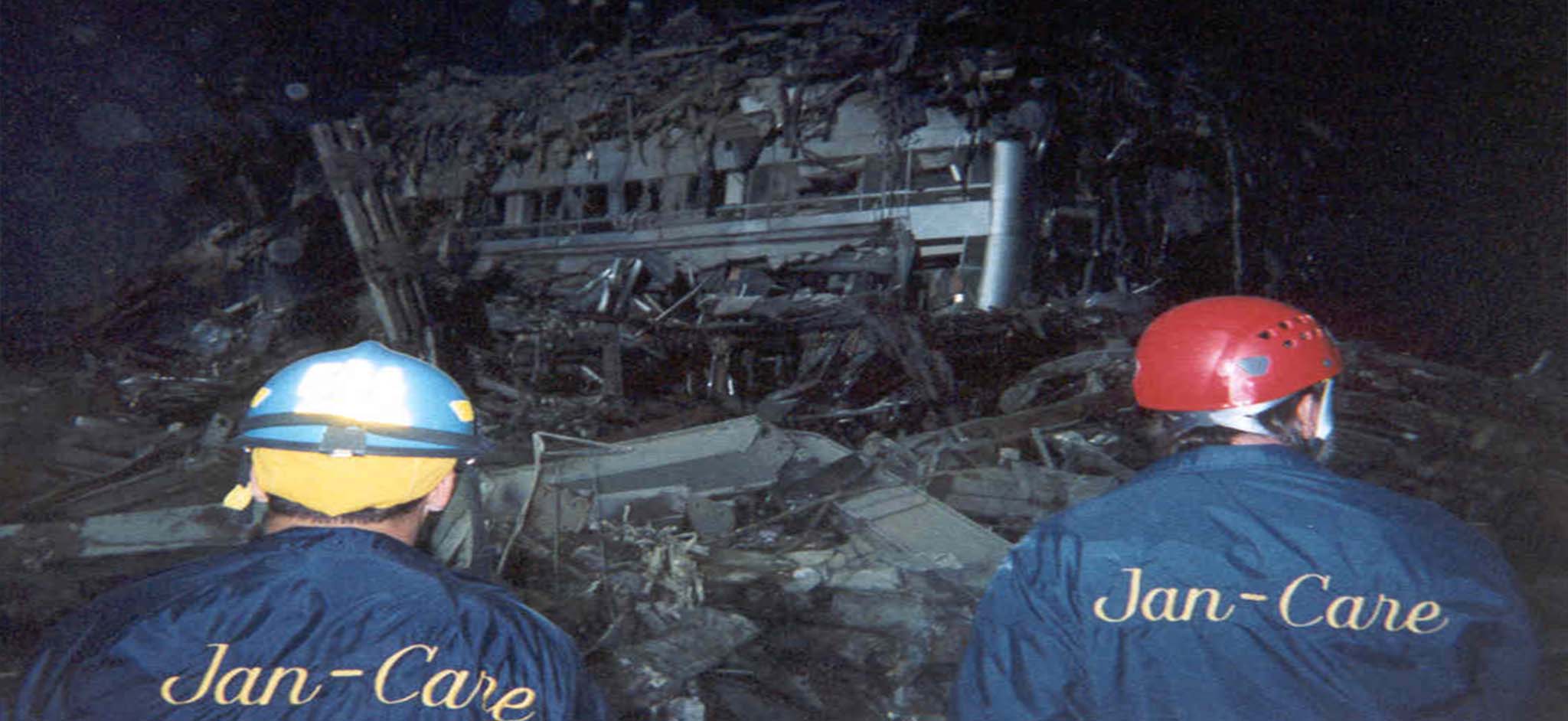
Near dark on September 12—roughly 36 hours after the attacks began, while the World Trade Center site was still officially considered a rescue operation—the Jan-Care Emergency Response Team was selected for deployment across the Hudson River. The crew traveled by supply ferry to Battery Park in lower Manhattan, near the World Trade Center site.
There, Jan-Care joined response teams from across the region in the organized and methodical search-and-rescue operation. After an extended deployment and near exhaustion, the team was released for a short break and returned to Battery Park, where members slept for a few hours on park benches before returning to the site.
After completing their response tour, the Jan-Care team departed the World Trade Center site by ferry and returned to Jersey City. By then, hundreds of ambulances, rescue units, and fire departments were lined up awaiting their own opportunity for deployment.
Humbled both by the scale of the destruction and by the enormous outpouring of support from across the country, the team eventually began the trip back to West Virginia. They arrived as a World Trade Center and 9/11 memorial service was being held at the Fayetteville Courthouse.
Many within the Jan-Care organization—each of whom had played a role in supporting the response—were privileged to see the team members standing beneath a furling American flag, their boots and uniforms still covered in the dust of Ground Zero.
The members of the response team have always understood that Jan-Care's deployment on September 11 may not have changed the fate of the victims of that terrible day. But it left everyone in the organization humbled and proud to be citizens of a country that, in its darkest hour, did not shrink from fear but answered the call of those in need.
That spirit of service remains part of Jan-Care's identity today.